

When everyone is talking about the latest model release, it’s easy to think the goal is simple:
“Find the smartest model and build on it.”
I don’t think that’s actually the goal.
Over the last several months we’ve seen incredible jumps in model capability. Some models are phenomenal for coding. Others are fantastic at reasoning. Others are incredibly fast.
And honestly…
It’s never been a better time to be building with AI.
But one thing that has really stood out to me is how quickly things change.
A model that feels untouchable today might have different pricing tomorrow.
A feature that’s available this week might disappear next month.
Access tiers change.
Safety policies evolve.
Rate limits change.
Sometimes governments even get involved.
None of that necessarily reflects poorly on the companies building these models.
It’s simply the reality of working at the frontier.
That has changed how I think about AI architecture.
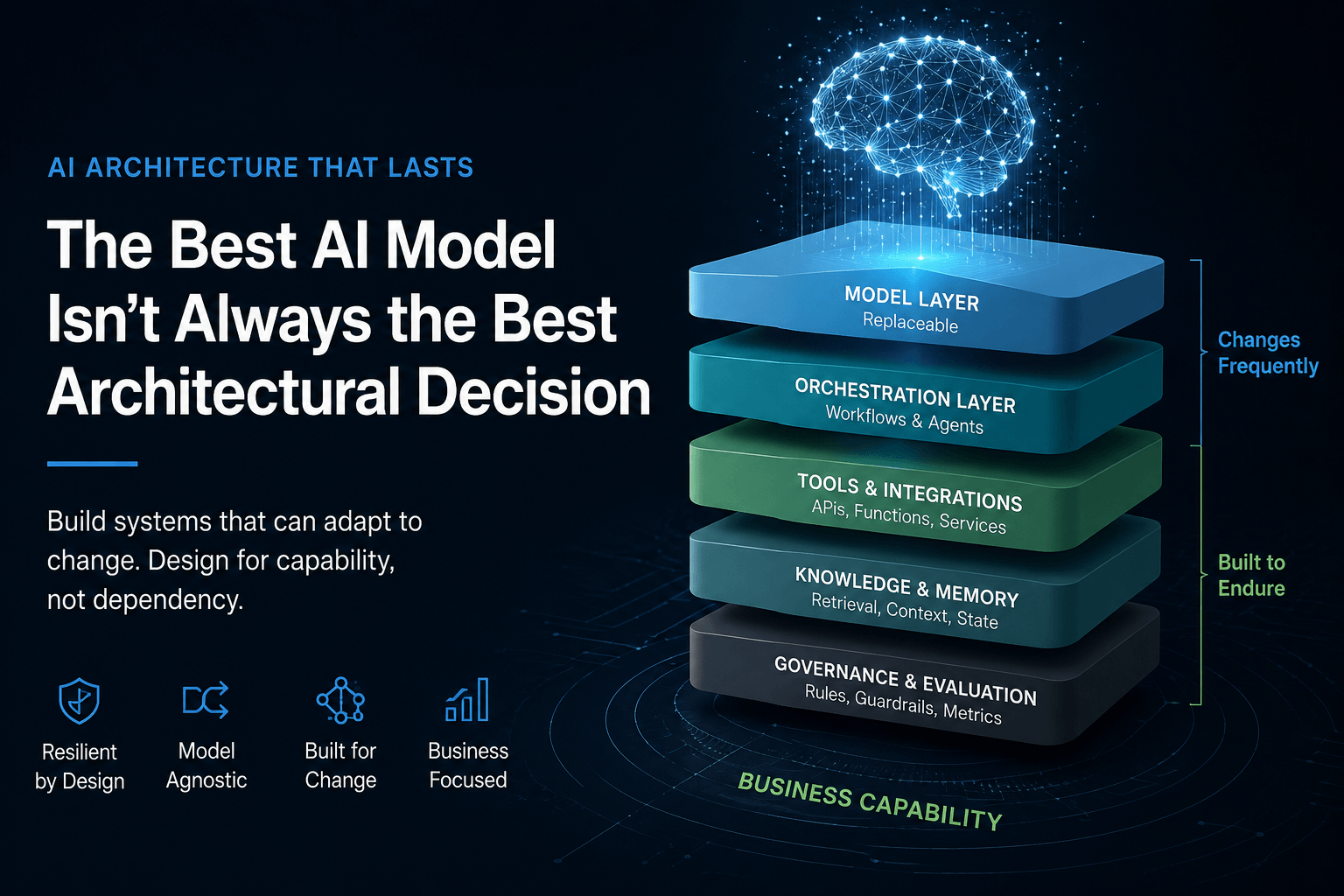
When I’m designing an agentic system, I try very hard to make sure the business capability doesn’t live inside the model.
Instead, I want the model to be one component of a larger system.
The workflow.
The memory.
The tools.
The governance.
The retrieval layer.
The evaluation criteria.
Those are the things I want to survive if tomorrow’s “best model” becomes next year’s forgotten release.
That’s why I don’t think enterprises should chase models.
They should build systems that can take advantage of whichever model is best today—and still function if that changes tomorrow.
The companies that win won’t necessarily be the ones using the smartest model.
They’ll be the ones whose architecture is flexible enough to keep improving as the models evolve.